
FAMUYA WALE SOGLOBAL CENTERFOR STRATEGY, POLICY, RESEARCH & PUBLISHING
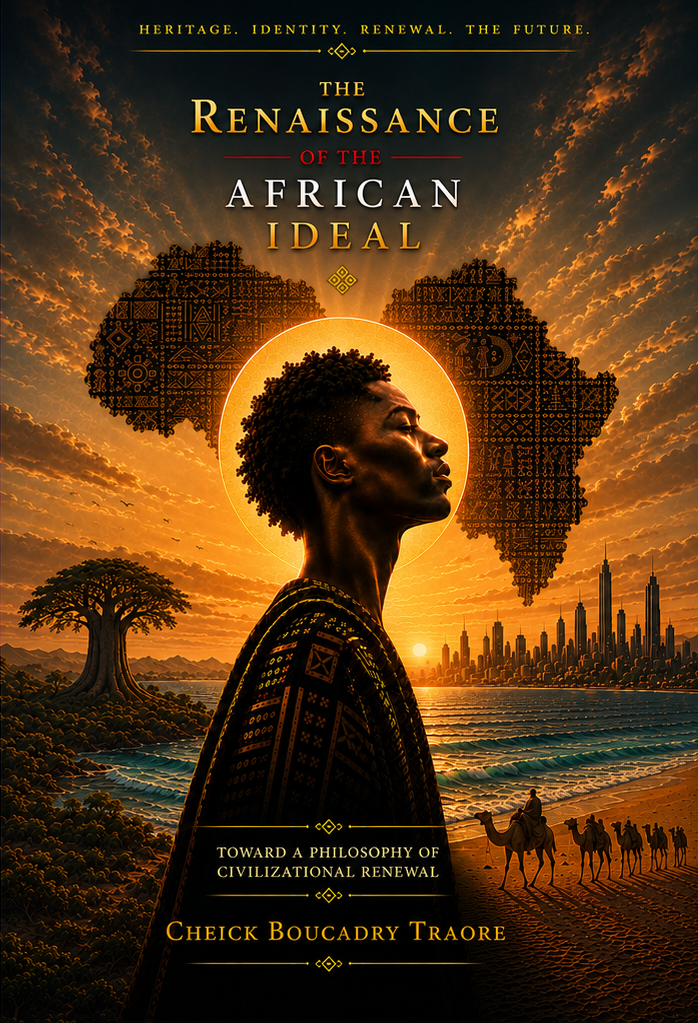
The Renaissance of the African Ideal book cover

HOME  >  PUBLISHING  >  EXPLORE THE BOOK

The Renaissance
of the African Ideal

Toward a Philosophy of Civilizational Renewal

Cheick Boucadry Traore

What does it mean for a civilization to remember—not to retreat into the past, but to become capable of creating the future?

OFFICIAL BOOK DESCRIPTION

A Civilizational Invitation

The Renaissance of the African Ideal: Toward a Philosophy of Civilizational Renewal is an invitation to reflect upon Africa’s renewal and upon the responsibilities that renewal places before Africans, the wider African world, and humanity itself.

Cheick Boucadry Traore argues that Africa’s future cannot be built through memory alone, nor through imitation, grievance, or the simple accumulation of material wealth. Renaissance begins when memory becomes responsibility, identity becomes creative confidence, knowledge becomes capability, values become institutions, and inheritance becomes preparation for those who will follow.

Moving through history, governance, family, education, leadership, citizenship, productive work, economic sovereignty, institutions, continental solidarity, and intergenerational responsibility, the book places the Human Person at the center of development. Its central conviction is that Africa’s greatest resource is ultimately not what lies beneath its soil, but what can be awakened within its people—the capacity to think, create, cooperate, build, govern, and contribute with dignity.

The African Ideal developed in these pages is therefore not a fixed model and not a return to an ancient world. It is a civilizational orientation toward dignity, responsibility, family, community, dialogue, meaningful work, justice, solidarity, stewardship, knowledge, creativity, belonging, and the continual renewal of life. It seeks an Africa able to remember without becoming imprisoned by memory, learn without disappearing into imitation, build strong nations without abandoning continental solidarity, and participate confidently in the human conversation.
A LIVING VOCABULARY

The Civilizational Codex

Woven through this journey is a Civilizational Codex of nine African symbols—silent teachers carrying lessons about life, memory, human dignity, work, dialogue, collective deliberation, stewardship, hope, and renewal.

These symbols are not presented as ornaments, but as a living vocabulary through which inherited wisdom can speak again to the present.

LIFEMEMORYHUMAN DIGNITYWORKDIALOGUECOLLECTIVE DELIBERATIONSTEWARDSHIPHOPERENEWAL

THE STORY OF THE COVERS

TWO COVERS TELL ONE STORY

A civilization remembers in order to move forward.

The front and back covers form one continuous narrative: from awakening to action; from receiving an inheritance to preparing one for the next generation. The front places the African person at the center of heritage and possibility. The back turns that promise into cultivation, education, institution building, and transmission. Memory and modernity share the same horizon.

“Nostalgia wishes to return. Renaissance remembers in order to move forward.”

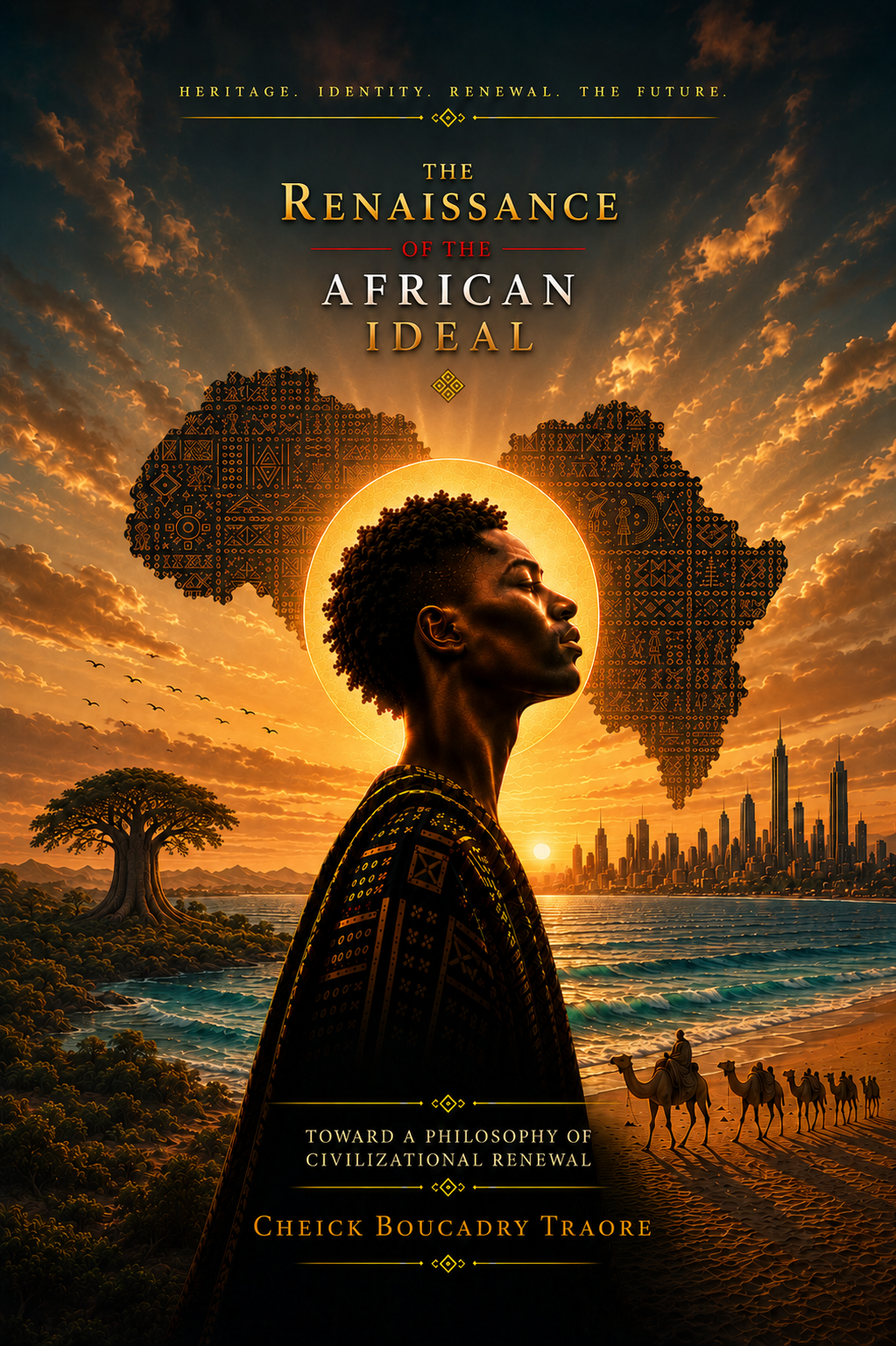
Front cover of The Renaissance of the African Ideal — The Awakening

The Front Cover — The Awakening

The African person
The motifs woven into his clothing and inscribed across the map of Africa represent heritage and identity. Africa is carried within him, in body, mind, and soul, as he looks toward the future.
Red “of the” and white “African”
Red recalls blood shed in defense of African homelands against foreign occupation and in the struggle for freedom from colonial rule: sacrifice, resistance, and self-determination. White expresses peace, solidarity, unity, open hands toward humanity, peaceful coexistence, and human brotherhood.
The rising sun and modern city
The sun illuminates the person’s face in awakening: every day offers another beginning, and every generation another opportunity to accept its responsibilities. The city speaks of human ingenuity, education, knowledge, construction, and possibility.
Water
Clean blue water evokes life, renewal, hope, harmony, and responsible stewardship. Rivers, lakes, seas, and underground waters sustain the well-being of the continent’s people. What gives life must also be protected.
The baobab and green landscape
The great Tree of Life bears witness across generations: memory, resilience, continuity, and civilization. Around it, green land evokes hope, fertile soil, agricultural and pastoral traditions, modernization, productivity, and the responsible use of natural abundance.
The camel caravan
The desert is a place of life, history, culture, movement, adaptation, and resources. The camel carries what survival requires across difficult terrain; the caravan recalls communities seeking exchange, pasture, water, opportunity, and a better life.
Birds, open sky, and golden light
Birds invite discovery, the acquisition of knowledge, and relationships beyond familiar horizons. The open sky offers possibility without imposed limits. Golden light recalls Africa’s mineral wealth and the responsibility to transform it wisely for present and future generations.
Red remembers the sacrifice. White affirms the peace toward which that sacrifice must ultimately lead.

At the horizon, nature and the modern city meet. The person carries his heritage into tomorrow, awakened to what has been entrusted to him and to the promise he must uphold for those who follow.

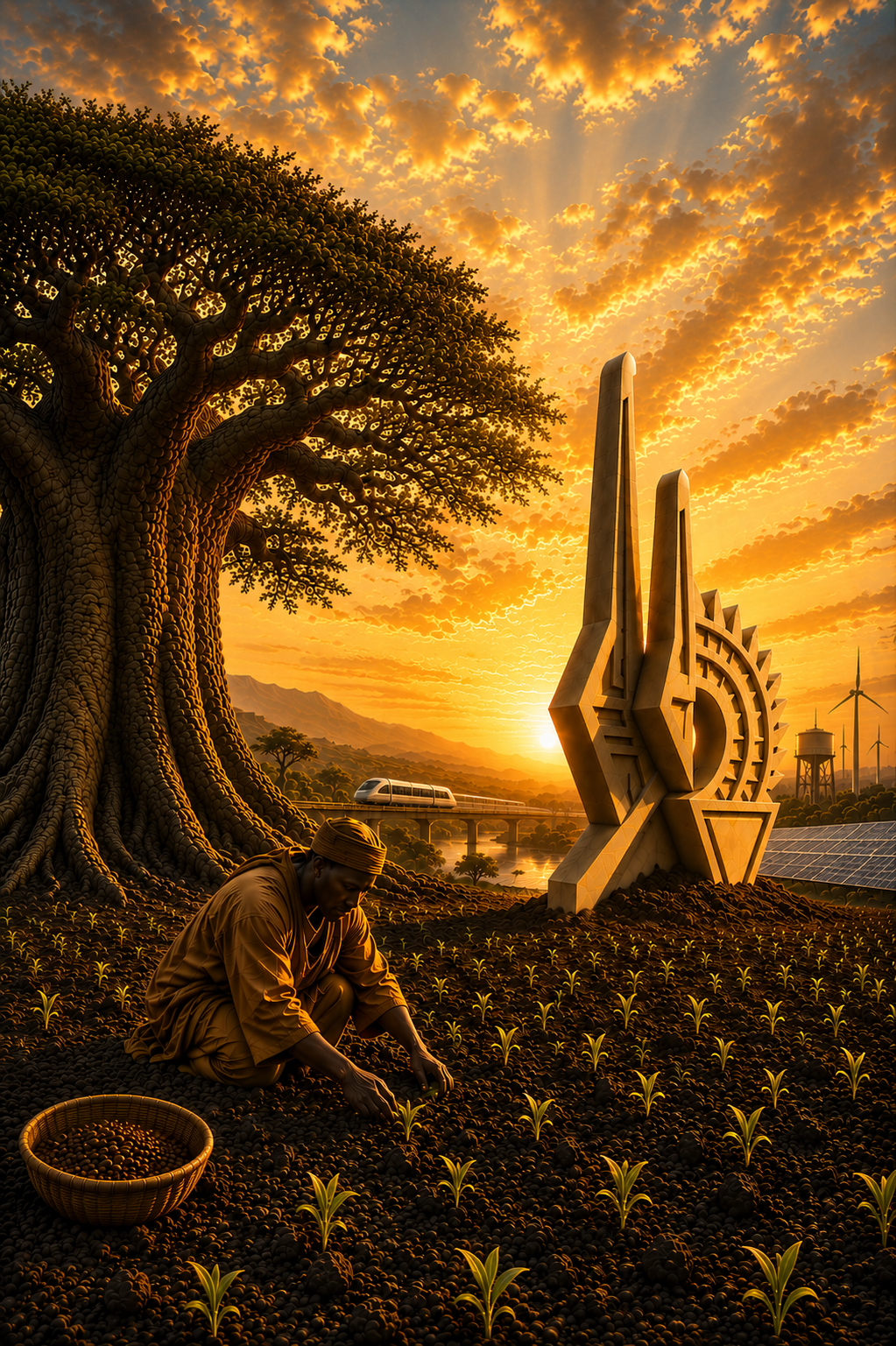
Back cover of The Renaissance of the African Ideal — The Promise Kept

The Back Cover — The Promise Kept

If the front cover represents awakening and promise, the back cover represents responsibility fulfilled.

Cultivating the earth
A person works directly with the earth: contemplation has become action and responsibility. The seed has been planted.
Sambalaɲɔ and the seedlings
The young plants represent what one generation deliberately prepares for another. We may not live to enjoy everything we create; some things must be planted precisely because someone else will need them. Beyond agriculture, the seedlings signify institutions being built, children being educated, knowledge being transmitted, capacities being formed, resources being protected, and possibilities being created for people who have not yet arrived.
Ciwara
The spirit of Ciwara expresses cultivation, work, discipline, responsibility, productivity, and collective effort. Aspiration must be sustained by action: soil worked, knowledge cultivated, and institutions maintained. Each generation contributes its labor to the inheritance it will transmit.
The baobab
The tree that witnessed awakening now witnesses responsibility fulfilled. Inherited memory and what is newly planted share the same landscape.
Modern human capacity
Transportation, renewable energy, infrastructure, and technology connect communities and economies, capture the forces of nature, and extend human capacity. The baobab stands beside them: modernity and memory inhabit the same horizon.
The old tree and the new seedlings belong to the same landscape. The old protects memory; the young carries continuity.

We are preparing an inheritance

A generation receives an inheritance, understands it, cultivates what remains valuable, adds something worthy of its own, and transmits an enriched inheritance to those who follow. The front asks what a generation will do with what it has received. The back answers through action. Between the promise and the promise kept lie the pages of the book.

REMEMBER. BUILD. TRANSMIT.

Between awakening and transmission stands the work of a generation.

THE HORIZON

An Africa Conscious of Itself

Structured around three movements—Remember. Build. Transmit.—the book ultimately asks what kind of inheritance this generation will prepare. Its horizon is not African isolation or civilizational superiority, but an Africa conscious of itself, capable of contributing to humanity, and willing to help build a future founded on dignity, justice, dialogue, solidarity, responsibility, and the common good.

We are preparing an inheritance.
We are inviting a generation to become worthy of one.Remember. Build. Transmit.